Quick answer
Poly‑B piping does not prove that a home has an active leak, but its presence is a reason to assess the plumbing and plan rather than wait for an emergency. A whole-home replacement normally includes documenting the existing system, choosing practical access routes, replacing distribution lines and fittings, completing required permit and inspection steps, testing the new system, and repairing the openings used for access. Insurance and resale effects vary, so homeowners should obtain property-specific advice instead of relying on blanket claims.
Polybutylene water-distribution pipe was installed in many Canadian homes, including Calgary homes built or renovated during the period when the product was in common use. Because most piping is concealed, homeowners may be unsure what they have or what a responsible replacement involves.
LBProjects treats Poly‑B replacement in Calgary as a coordinated home-renovation project: plumbing is central, but access, protection, drywall, painting and daily water interruptions also need a plan.
How can I identify possible Poly‑B piping?
Poly‑B is commonly a flexible grey plastic pipe, although colour alone is not enough to identify it. Accessible pipe near the water heater, mechanical room, utility ceiling or under sinks may carry a marking such as PB2110. Copper stub-outs at fixtures do not rule out Poly‑B elsewhere in the walls.
A homeowner can photograph accessible markings, but a qualified plumbing assessment is more reliable. Do not remove finishes or disturb suspect materials simply to search for pipe.
Why do Calgary homeowners consider Poly‑B replacement?
The concern is not that every length fails on a predictable date. Performance depends on the system, fittings, installation, operating conditions and history—many of which are hidden. A visual inspection of exposed pipe cannot guarantee the condition of the concealed system.
Homeowners commonly choose planned replacement for one or more of these reasons:
- Known leaks, staining or previous plumbing repairs
- A renovation is already opening walls and ceilings
- A desire to reduce uncertainty around concealed distribution piping
- Questions raised during an insurance application or property transaction
- A wish to complete repairs on a controlled schedule instead of after water damage
Low pressure, discoloured water or damp finishes can have many causes and are not a reliable DIY diagnosis of Poly‑B failure. Active leaking, bulging ceilings or unexpected water should be addressed promptly by the appropriate professional.
What does a whole-home Poly‑B replacement include?
1. Existing-system inventory
The team identifies fixtures, manifolds or branch lines, shutoffs, mechanical equipment, finished areas and accessible routes. Previous renovations may have replaced only part of the system, so “some PEX” does not necessarily mean “no Poly‑B.”
2. Access and protection plan
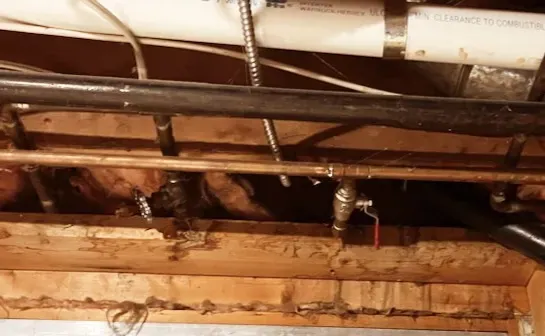
New pipe must reach kitchens, bathrooms, laundry, hose connections and mechanical equipment. The plan should favour controlled openings and accessible routes while protecting floors, furnishings and occupied areas.
3. Replacement design and plumbing work
A qualified plumber selects an appropriate approved piping system and fitting method for the home. The scope should state what is replaced, what remains, how shutoffs are handled and how abandoned piping is treated.
4. Permit, inspection and testing
The City of Calgary states that a plumbing permit is required when a plumbing system is constructed, extended or altered, including replacing water lines. Confirm who will obtain the permit, which inspections apply and how the system will be tested before openings are closed.
5. Restoration
Drywall, texture, paint, trim and cabinet access panels may be part of the project. Define the finish standard in writing: a plumbing-only price and a complete restored-home price are not comparable.
| Scope area | Questions to resolve |
|---|---|
| Pipe coverage | Does the price include every hot and cold distribution line, exterior connection and affected fixture? |
| Access | Who opens ceilings, walls, cabinets or tile, and where? |
| Regulated work | Who obtains the permit, performs the plumbing and books inspections? |
| Water service | How long will water be off, and will service be restored at the end of each workday? |
| Restoration | Are drywall, texture, paint, trim and cleaning included? |
| Documentation | Will you receive permit records, product information, photos and warranty details? |
What affects Poly‑B replacement cost and disruption?
Square footage is only one variable. Important cost drivers include:
- The number of bathrooms, kitchens and other water connections
- How many storeys and finished ceilings the piping crosses
- Finished basements, tiled walls, built-ins and difficult cabinet access
- Whether pipe can be routed through mechanical rooms or unfinished areas
- The amount and standard of drywall and paint restoration
- Occupancy, furniture protection and daily cleanup requirements
- Related work such as shutoff upgrades or planned room renovations
Combining replacement with a kitchen, bathroom or basement renovation can make sense when those areas are already open. Coordination should be planned: one project should not damage newly completed work from another.
Questions to ask before work begins
Will replacing Poly‑B lower my insurance premium?
That decision belongs to the insurer. Ask your broker or insurer in writing what documentation they require and whether replacement changes coverage or pricing. A contractor should not promise an insurance outcome.
Will it increase resale value?
Replacement can remove a known concern for some buyers, but market value depends on many factors. Keep permits, invoices, photos and a clear description of what was replaced so a future buyer can understand the work.
Should we replace copper with PEX, or Poly‑B with copper?
There is no single answer for every home. Material selection, sizing, joining methods, routing and installer qualifications all matter. The plumber should specify an approved system appropriate for the project.
Can we replace only the visible sections?
A partial replacement may be appropriate for a repair, but it does not represent whole-home removal. The proposal should identify every area that remains so the homeowner understands the result.
Plan the access and restoration as carefully as the pipe
The best replacement plan does more than swap one material for another. It maps the whole system, limits unnecessary damage, verifies regulated work and restores the home to an agreed finish. That is what turns a plumbing concern into a manageable renovation scope.